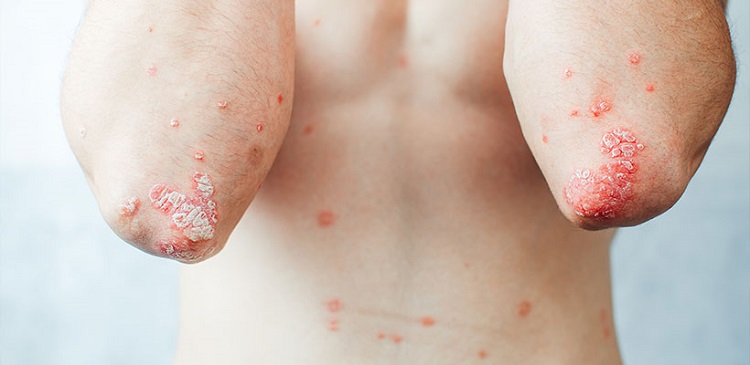
Psoriasis (from Greek psora = scab) is a chronic inflammatory skin disease characterized by sharply defined red plaques covered with dry, silvery-white scales. Besides the skin, the disease often affects the scalp and nails, and in some patients, it can also affect the joints in the form of psoriatic arthritis.
Epidemiology
About 1-3% of the global population suffers from psoriasis. The highest prevalence is in Scandinavian countries (3%), while the lowest is among Native Americans in North America (0.5%). In Croatia, approximately 80,000 people suffer from psoriasis. Psoriasis can occur at any age, but in 50% of patients, it appears before the age of 25.
Etiology
The specific cause of the disease is not fully known. It is believed that psoriasis develops as a result of the interaction of inherited genetic factors and various environmental factors. It is now considered that psoriasis is inherited in a polygenic manner – a combination of multiple genes located on different chromosomes is responsible for the development of the disease. Among them, the most crucial genes are located on the short arm of chromosome 6, whose primary role is the regulation of the immune response. It is precisely immune factors and cells like T-lymphocytes, which are involved in the immune response, that trigger the inflammatory process in psoriasis.